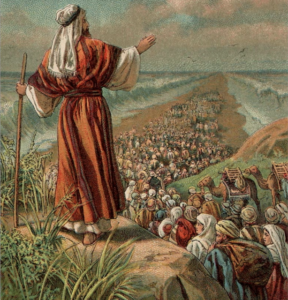
Did we flee Egypt, as is outlined in the book of Exodus? Were we ever enslaved there? For as much as the story has been repeated, there is no archaeological evidence that it is based on fact (though, admittedly, it’s an odd one to concoct). As climate activists and organizers, it doesn’t matter whether the story is history or allegory; the most important fact is that we are in a version of Egypt now.
Exodus and the passage “My Father Was A Wondering Aramean” (Deuteronomy 26:5-11) is a tale chased by the specter of poverty and starvation. There is a problem with resources: What are we producing? How are we producing it? And, most importantly, why are we producing it?
It is the first of the many unnamed pharaohs who recognizes the problem, and it is this that brings him to Joseph. Whether a prophetic dream or his own anxieties, pharaoh can see that he and his dominion have “enough” at that moment, but what will the future bring? Joseph nods his head in understanding, and affirms that this is something that an empire should be concerned with. He designs a system of grain storage that sees Egypt through a famine, and he and his family are rewarded for his planning.
It is telling that one of the reasons that later pharaohs get so exercised about the Israelites is that their population grows so quickly. Everything else aside, that’s difficult to do unless there is enough food. Whatever system of agricultural storage Joseph and his successors designed, from pharaoh’s perspective, it seems to be working all too well.
When the Israelites arrive in the promised land after forty years of wandering in the desert—time enough, perhaps, to rethink the systems they were part of in Egypt—they are commanded not only to give the first fruits of the soil to god, they were also told to feed the most vulnerable in their communities and to leave parts of their fields untouched so that those without land could glean crops there. It doesn’t say anywhere that they are not allowed to store crops for leaner periods, but the priority is making sure that everyone in the community is taken care of in the here and now. Because that is the answer to why we go to all of this trouble in the first place.
We have not perfected food distribution—though, we promise, there is plenty of food to go around for everyone—but what we are chased by today is intimately connected to resource extraction and distribution. Our climate emergency is the result of pollution and environmental degradation in the name of energy usage.
Our current standard of living is not sustainable, nor was it preordained. As with Joseph’s system of agricultural storage, it was designed to meet medium-term needs, and without an understanding of what the consequences would be. But even if we could wave a magic wand to stop fossil fuels from emitting carbon dioxide and methane—or to make rare earth elements somewhat less rare—our system of extraction would still be unjust in ways that the enslaved of Egypt would immediately recognize.
Our system harms those who perform the most work in it, while offering them the least of any benefits. Just as our ancestors labored under food insecurity, those who work in areas where fossil fuel extraction is the most concentrated are among those who will pay the highest prices for energy. And the most vulnerable among us, rather than being taken care of by the community, are instead more likely to be forced to “host” waste, including from the energy industry.
Deuteronomy describes a system that is not perfect; in many ways, it’s “messy”, but this leaves open the possibility for innovation. It is also demonstrably better than the one it preceded. It is not fit for an empire, but for a community.
Perhaps the most fanciful part of Exodus is the idea that there is somewhere to escape to. The truth of our present is that we have to transform Egypt into a promised land, or, if you prefer, a land of fulfilled promise.
Today, our energy system is so far from perfection that demanding a design for such would paralyze all of us. Unfortunately, we don’t have forty years to forget, and we have to ask for both “better” and “enough” right away. That definition of “enough” needs to reflect what is equitable—or possible—for everyone, because that is who is really in our “community”. That is the promise, and that is also the why.