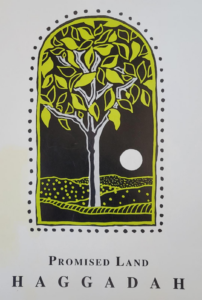
As with many other religions, Judaism is connected to agricultural cycles. However, our ancestors had deeper insights into the ways in which humanity and culture interacted with our environment, and we see those insights reflected in our holidays. The late Rabbi Ellen Bernstein’s brilliant haggadah, The Promise of the Land, provides us with many clues as to what our ancestors were trying to communicate to us. As you plan your Pesach celebration this year, we ask that you sit for a few minutes with the definitions of these words. Do they change the way you approach this coming week?
Pesach has numerous meanings, including those linked to “passing over”, “having pity”, “make soft or soothe”, “placate”, or, “the taking mouth”. It is a holiday deeply connected to eating as well as speaking as one form of communication. It is at heart an interactive time, and as such, one that requires community, however small.
Jewish culture has never existed in a vacuum: we have shaped other cultures, and we have been shaped by them. We can see that reflected in our vocabulary, even on this holiday. Karpas, the bitter herbs we are commanded to eat, has either Greek or Persian roots, depending on whom you ask. That speaks not only to our interactions with people who spoke those languages—some of whom were Jewish—but the ways in which the seder as well as the holiday have evolved.
Torah translates to “law”, but also “teaching” and “instruction”. The word implies not only that the books are the location where the law is conveyed, but that the books are an active place of learning. This helps put into context the haggadah, or “telling”, we use for the holiday. Haggadah is derived from the word “l’haggid”, which means “to tell”. Maggid is connected to the same root word, and means not only the person who preaches, but the act of retelling. On this holiday, we are particularly commanded to retell a certain chapter of our history, and in doing so, we make history not a static recollection, but an active reflection—a verb, even—that connects to our present.
Pesach is closely connected with agriculture, which takes place on and in the earth. The words for “earth” in Hebrew are eretz and adamah, and both speak to the human connection to our environment. Eretz should be understood not only as the physical location of land or a political entity, but Land, as described by Dr. Max Liboiron in their book, Pollution is Colonialism. Land with a capital L is more than a patch of dirt; it is an ecological reality, not a political or economic construct, that encompasses living soil, the geographic features of the area *and* how they interact with each other, the flora and fauna, the humanity that has and continues to live not on but with the area, and the history and culture that the area has made possible. (Deb is reminded of her mentor, the late Willie Brown of Roxbury, who taught a similar lesson about compost almost two decades ago.) In contrast, adamah, or “red clay”, would seem more humble but for the clear relationship to adam, or “human”. Those two words remind us that we are, literally, of the earth.
Whether we are devoutly Orthodox, Jewish atheists, or anything in between, it is almost impossible to avoid the word “god”. Rabbi Bernstein wrote that the Hebrew name of god is spelled יהוה—yud, hay, vav, hay—or Yahweh, and that two of the translations of that name are “one who causes being” and “one who connects all things”. While there are innumerable ways to interpret those concepts, we humbly offer that they perfectly align with an understanding of the ecological interconnections of all life on our planet.
All Jewish holidays implicitly ask what it means to be Jewish. Before there was a political entity known as Israel, the Jewish people were referred to as Israel (and sometimes still are). Israel was the name the patriarch Jacob earned after he struggled with an angel, and one meaning is “one who wrestles with god”. That is generally taken to mean that we should continuously ask questions of Judaism, but what does it mean if we combine it with the above interpretations of god?
Pesach is the story of our exodus from Egypt, or Mitzrayim, “strait” or “the narrow place”. Perhaps anyone who has ever felt constrained or confined can recognize why we would see the place of our bondage as narrow. How easy is it to “wrestle” in a narrow place? What is the difference between the answers we arrive at in a narrow place and one that is more expansive?
Many of us believe that one of the pillars of Judaism is avodah, or service. That word means both worship and physical labor, and implies, once again, that Judaism is active, not receptive. As our Steering Committee member Lynn Nadeau wrote in her Promised Land Haggadah, “…words are the first step to action and change,” and “Pesach is a call for action.”
Finally, dayeinu is probably the word most closely associated with Pesach. We like the concept our friend Rabbi Nina Cardin used in her most recent book, To Forever Inhabit This Earth: An Ethic of Enoughness, and we also find ourselves nodding along to Rabbi Bernstein’s definition of dayeinu as “radical appreciation”. While we sing the song during the seder, what are other moments that we can bring that appreciation into our lives? And how can we connect that with the eretz, adamah, and god?
We hope this vocabulary primer has given you new ways to look at Pesach, and we hope you’ll share your thoughts with us as well.
Chag Pesach Sameach!