

Overview
Visit four Massachusetts miniforests and explore how the Miyawaki Method is being adapted across diverse landscapes and communities.
Saturday, July 18, 2026 | 8:30 AM–5:00 PM ET
Starting and ending at Somerville High School, Somerville, MA
Join us on Saturday, July 18, for a full-day tour of four Massachusetts miniforests that showcase the diverse ways the Miyawaki Method is being adapted across the region.
From dense urban neighborhoods and school campuses to restored agricultural land and post-industrial landscapes, participants will visit sites at different stages of development and learn directly from the practitioners, researchers, municipal leaders, and community members who helped bring them to life.
Space is limited and advance registration is required.We kindly ask participants to arrive between 8:30 and 8:45 AM so that we can begin the tour promptly. A boxed lunch will be provided.
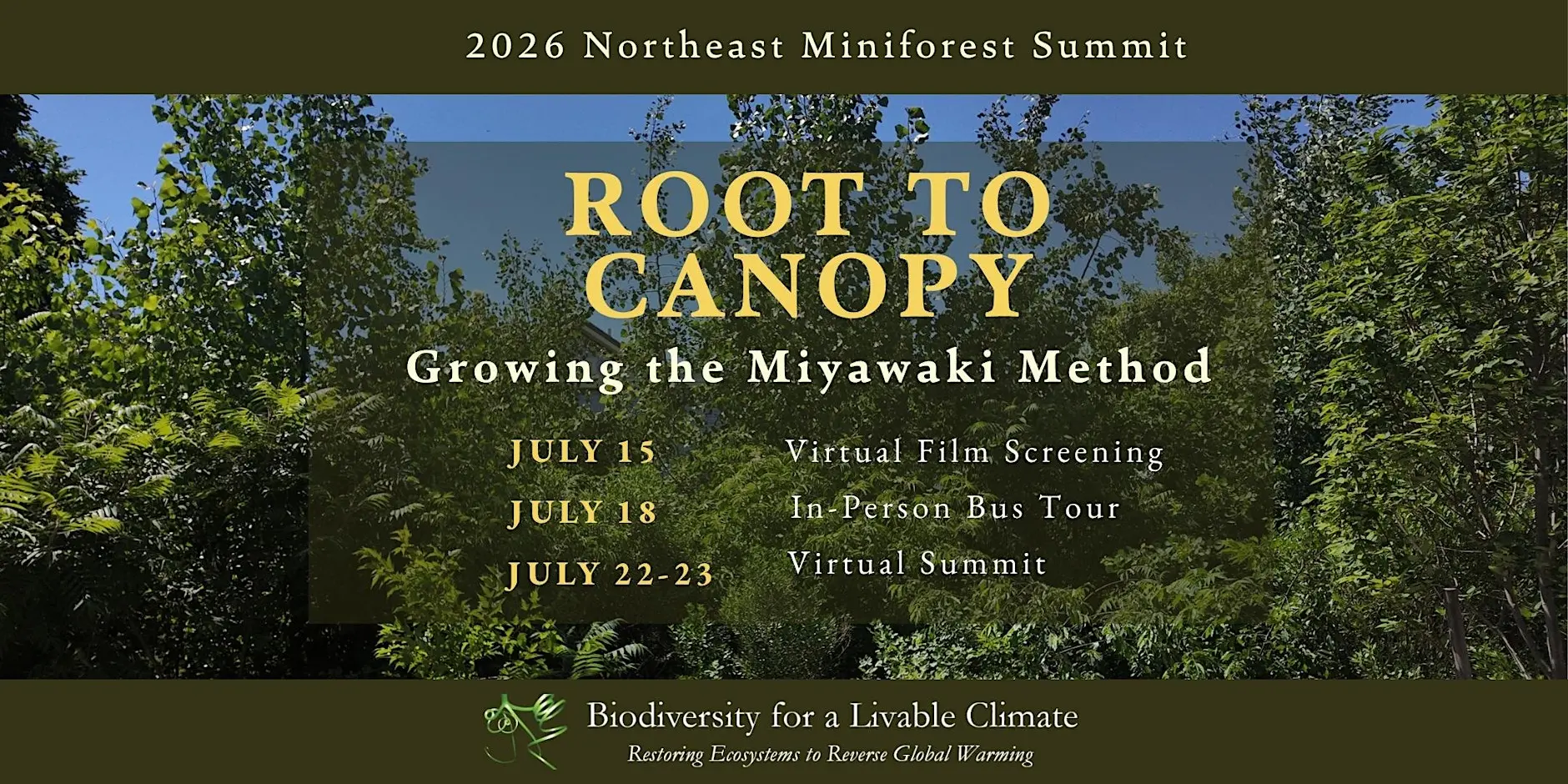
The bus tour is part of the 2026 Northeast Miniforest Summit. Bringing together practitioners, researchers, educators, landscape architects, municipal leaders, and community organizers, the Summit creates space to share experiences, exchange knowledge, and learn from projects unfolding across diverse ecological and social contexts.
Building on the momentum of the inaugural 2025 Summit, this year’s program includes two virtual half-days, an in-person bus tour of Massachusetts miniforests, and a special pre-Summit screening of filmmaker Angelina Lee’s documentary Making a Mini-Forest.
Learn more at miniforests.bio4climate.org
What is the Miyawaki Method?
Developed by Japanese ecologist Dr. Akira Miyawaki, the Miyawaki Method creates dense, diverse miniforests using native trees and shrubs. By preparing the soil and planting at high density, these forests can establish quickly—even in urban environments—supporting biodiversity, improving soil health, retaining water, cooling neighborhoods, and creating opportunities for community stewardship.
Watch this video to learn more:
This urban forest becomes self-sufficient in three years
This event is organized by Biodiversity for a Livable Climate.For more information, visit miniforests.bio4climate.org or email miniforests@bio4climate.org with any questions.
About Biodiversity For a Livable Climate
For more than a decade, Biodiversity for a Livable Climate has worked to raise awareness about the vital role of biodiversity and nature-based solutions in regulating the Earth’s climate.
A pioneer of the Miyawaki Method in the United States, the organization helped bring this approach to New England, launching the region’s first miniforest in 2021 in collaboration with SUGi and the City of Cambridge. Since then, it has supported the planting of eight miniforests across Massachusetts, demonstrating how this approach can take root across diverse urban sites. In 2025, Bio4Climate convened the inaugural Northeast Miniforest Summit—mobilizing a regional network of practitioners to exchange knowledge, build relationships, and support the continued emergence of miniforests across the region.